
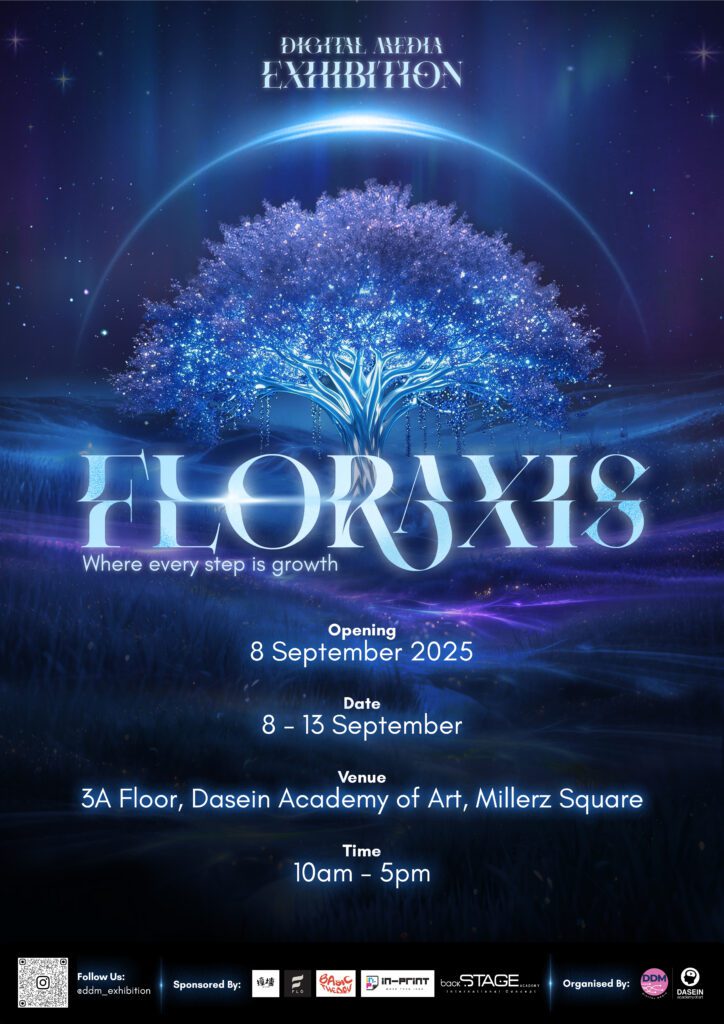
FLORAXIS is a Digital Media Final Year Exhibition that highlights the role of quality education and personal growth in shaping communities and society through multimedia design and technology. The exhibition features 12 multimedia projects, with each project aiming to educate the public on everyday knowledge and issues using technology-based approaches. Collectively, the works seek to empower new understanding and inspire positive change in small but meaningful ways.
Watch the event video recap below.
Below are all the projects that were showcased by DDM231 Digital Media students.
Mission Heimlich by Tan Jia Er | Interactive Heimlich Maneuver Training Kit.
Mission Heimlich addresses the low public awareness and lack of confidence in performing the Heimlich manoeuvre in Malaysia. While many people have heard of the technique, most have never practised it, leading to hesitation during real choking emergencies where every second is critical. Mission Heimlich provides a hands-on interactive learning experience using a physical puppet with sensors and motion graphic guidance. Users learn the correct steps for infants, children, adults, pregnant individuals, and self-rescue. A timed rescue challenge helps reinforce speed and accuracy. By allowing users to practise with real-time feedback rather than only observe, the project strengthens both understanding and confidence, enabling quicker and more effective response when choking occurs.
Quake Quest by Lee Ven Xin | Educational Earthquake Simulator
Quake Quest responds to the growing seismic risk in Peninsular Malaysia, where earthquake safety education remains limited, especially for children. Without clear guidance or practice, many may not know how to respond effectively when an earthquake occurs, increasing the risk of injury.
The interactive anamorphic animation in Quake Quest teaches children aged 4 to 12 the correct safety steps through guided movement and physical involvement. By following the character on screen, such as hiding under tables, avoiding falling objects, and navigating to safe exits, children learn by doing. This active engagement builds muscle memory, helping them respond more quickly and confidently in real emergencies. By making safety education immersive, approachable, and memorable, Quake Quest helps equip young learners with essential survival skills.
540 The Silent Gesture by Yong Su Yee | 540 Silent Hand Gesture
This project responds to the low awareness and understanding of the 540 Signal for Help in Malaysia, a silent hand gesture used to discreetly seek assistance in abusive situations. Many victims remain unheard because others do not recognise the signal or know how to respond. The Silent Gesture uses an interactive multimedia experience to teach users how to identify and perform the gesture correctly. Through a visual puzzle game and hand-tracking practice activity, users learn by actively engaging and building muscle memory. A PSA video and a wallet-sized pamphlet provide real-life context and essential hotline information. By combining recognition, practice, and clear response guidance, the project aims to empower the public to notice the signal and support those silently asking for help.
Our Conversation Ends Here, Period by Cheryline Chan Qin Wey | Sanitary Pad Interactive Installation (Kancil Awards Winner)
The interactive installation reframes menstruation as natural and life-giving, addressing the discomfort and shame many teenagers experience due to limited education and persistent cultural taboos. Although most people recognise menstruation as a normal biological process, only a small proportion feel comfortable talking about it. Boys, in particular, have fewer chances to learn, which further reinforces stigma and silence.
A large flower structure made from sanitary pads opens when a viewer approaches, symbolising growth, acceptance, and the recognition of menstrual experiences. Touch interaction then triggers motion graphics that connect menstruation with the moon cycle, encouraging viewers to understand it as a natural rhythm rather than something to hide. The installation offers a gentle, reflective space that promotes open discussion and helps reduce stigma surrounding menstrual health.
S.A.Y.A.N.G The Heart of Learning | Interactive Storybook / Projection
S.A.Y.A.N.G responds to the low levels of parental involvement in learning within under-resourced families. Many parents want to support their children but feel unsure due to limited education, lack of confidence, or busy work schedules. As a result, children may receive less encouragement at home, which can affect motivation and widen the learning gap. S.A.Y.A.N.G – The Heart of Learning uses interactive multimedia and storytelling to show parents how simple, everyday acts of care can support their child’s education. Through projection-mapped scenes triggered by a physical storybook, parents see how the S.A.Y.A.N.G method — Support, Ask, Yes, Attend, Notice, and Guide — can be easily practised at home. By reframing parental involvement as small, meaningful moments rather than formal teaching, this project encourages parents to feel capable, confident, and connected in their child’s learning journey.
Wall of Whispers by Ooi Jia Yi | Interactive Magic Wand
Wall of Whispers responds to the common misconception that introversion is a weakness or a lack of social ability. In many social and educational environments, extroverted behaviour is seen as more favourable, causing the quiet strengths of introverts to be overlooked or undervalued. Wall of Whispers uses a wizard-themed interactive projection installation to reveal these hidden strengths in a magical and meaningful way. By waving a wand to activate animated frames, users uncover traits such as deep empathy, thoughtful observation, self-awareness, and quiet confidence. The interactive “spellcasting” metaphor reframes introversion as a unique source of power, encouraging viewers to recognise and appreciate the strengths that are often expressed quietly rather than loudly.
Watch Out! Danger In Sight by Jermaine Wong | Eyesight & Screen Habit Tracker
This project addresses the rising issue of unhealthy screen-viewing habits among children and teens, which often lead to dry eyes, eye strain, and increased myopia risk. Verbal reminders are easy to ignore, and information alone is not enough to change behaviour. Watch Out! Danger in Sight uses real-time eye-tracking feedback to let users directly experience how improper viewing distance and reduced blinking affect visual clarity. By allowing the screen to blur, darken, or distort in response to the user’s habits, the project turns abstract eye-health warnings into immediate, felt consequences. This sensory learning approach encourages users to maintain healthier screen distance and blinking patterns, promoting long-term visual well-being.
What‘s The Rush by Lim Jia Jun | Interactive ASMR Film
What’s The Rush addresses the fast-paced lifestyle that many people experience in modern urban environments, where constant work demands and digital distractions leave little space for rest. Over time, this rhythm can lead to burnout and emotional exhaustion, making it difficult to slow down and be present. What’s The Rush? uses ASMR and ambient sound films to encourage a mindful pace. By giving viewers control over the playback speed during the experience, the installation reveals how the habit of rushing can persist even in calm and quiet moments. This interactive approach helps viewers recognise their own patterns and reflect on the value of slowing down, supporting healthier mental and emotional well-being.
Sugarcoated by Ling Qian Ping | Multimedia Appplication on Health-washing Product Packaging
Sugar Coated raises awareness of how packaging design can mislead consumers into believing that a product is healthy when its sugar content is actually high. Many products use bright colours, fruit imagery, and labels such as “low sugar” or “no added sugar” to appear healthy, even though the nutritional information tells a different story. In Malaysia, sugar consumption remains above recommended levels, contributing to rising rates of overweight and obesity.
The interactive application in Sugar Coated allows users to redesign packaging using common healthwashing tactics in a tablet application. By doing so, they experience how easily visual cues can influence perception. The redesigned packaging is then projection-mapped onto a physical box, supported by motion graphics that reveal the hidden sugar content. Through this hands-on experience, users are encouraged to look beyond first impressions, read labels carefully, and make more informed decisions about what they consume.
The Spectrum of Us by Vanessa Babs Dee | Interactive Application
The Spectrum of Us is an interactive multimedia installation that encourages self-acceptance and confidence among teenagers affected by identity-based bullying. Through interactive projection, fluid simulations, and hand tracking, participants experience a visual transformation from dark ink to vibrant colours and a blooming flower. This process symbolises the shift from hiding one’s identity to embracing individuality with pride.
Sekolah Dalam Hospital by Kelly Wong Shi Yai | Digital Campaign
This project is an awareness campaign about the Sekolah Dalam Hospital (SDH) programme, which supports students undergoing long-term medical treatment in hospitals. The project highlights the lack of public awareness and limited access to information that prevents many eligible students from benefiting from the programme. Using posters, brochures, a dedicated website, and an interview video, the campaign explains how SDH helps hospitalised children continue their studies, stay connected to education, and maintain a sense of normalcy during treatment.
Rise Of The Invisible Child by Cheong Yoke Ying | Digital Campaign
This project is a digital awareness campaign developed in collaboration with Dignity NGO to highlight the educational challenges faced by children from non-marital families, stateless communities, and refugee backgrounds. It addresses the lack of access to quality education and limited awareness of available support. Through a short documentary, printed materials, and digital outreach, the campaign shares the NGO’s farm-based learning approach and its role in empowering underprivileged children through practical skills, dignity, and sustainability. The project aims to bridge information gaps, raise public awareness, and improve access to educational support for marginalised children.